 Open
OpenIslamabad
Islamabad Capital Territory
Guesthouse rooms in F-6 and F-7 sell out four to six weeks ahead through wedding season, October to March.
from Rs 8,000/nightView stays
City hotel guide
Rawalpindi costs a quarter to a third less than the equivalent Islamabad sector and sits ten minutes closer to the airport. Saddar and the Cantt for the city, Chaklala Scheme 3 for early flights, Bahria Town Phase 4 for parking and weddings, Committee Chowk for budget. Doubles run Rs 6,000 to Rs 12,000.

This page is about deciding, not booking. If you already know the area and the dates, /hotels/rawalpindi is the shorter route — it carries the areas, the price bands, the season note and the enquiry form. Stay here if the decision is still open, because in Rawalpindi the decision is rarely just 'which hotel'. It is usually 'Rawalpindi or Islamabad', and then 'which side of Rawalpindi', and those two questions are decided by completely different things.
Almost nobody sets out to stay in Rawalpindi for its own sake. People end up here for one of five reasons: the price of the Islamabad F sectors, a flight before 7am, a road trip that starts on the Murree Expressway or at a coach terminal, a wedding in the Bahria Town marquee belt, or business in Saddar and the bazaars. Each of those points at a different part of the city, and picking the wrong one is how a saving of Rs 4,000 a night turns into two hours a day on Murree Road.
So the useful frame is not star rating. It is: what time do you leave in the morning, and from where.
The price gap is real and it is roughly a quarter to a third for a comparable room. A double that costs Rs 12,000 in F-7 typically runs Rs 8,000 in Saddar or Chaklala Scheme 3. Across the tiers, clean mid-range doubles in Saddar and the Cantt sit at Rs 6,000 to Rs 12,000, four-star properties in Bahria Town and Chaklala at Rs 15,000 to Rs 28,000, and budget rooms around Committee Chowk and Liaquat Bagh drop below Rs 5,000. On a five-night stay that gap is a domestic flight.
The second advantage is the airport, and it is the one people underweight. Chaklala Scheme 3, Airport Housing Society and the Bahria Town Phase 4 stretch sit 20 to 35 minutes from Islamabad International Airport depending on traffic. Saddar and Committee Chowk add another 15 to 20 minutes on top. If your flight is before 7am, staying on this side of the twin cities is not a saving so much as the removal of a genuinely unpleasant drive.
What you give up is quiet and predictability. Murree Road and Raja Bazaar clog from mid-morning until late evening, and Friday afternoons are worse. Rawalpindi is the older, denser half of the pair, and the streets were not laid out for the traffic they now carry. The Metro Bus along Murree Road is the honest counter-argument — it links Saddar to Faizabad and on to Islamabad's Blue Area for a few rupees, and most visitors never use it.
For an early flight, Chaklala Scheme 3 or Airport Housing Society, and stop looking. Twenty to thirty-five minutes to the terminal is the whole argument, against another fifteen to twenty minutes on top of that from Saddar or Committee Chowk, and at 4am the difference is not academic. Bahria Town Phase 4 sits on the same side and adds secure parking, which matters if you are leaving a car behind.
For working in Islamabad on a Rawalpindi budget, stay on or near the Murree Road corridor and use the Metro Bus rather than driving. The route runs Saddar to Faizabad and connects into Blue Area, it costs almost nothing, and outside rush hour it is more predictable than a car on the same road. Book the room on the corridor rather than deep in Bahria Town, because the bus is only an advantage if you can reach it on foot.
For a wedding, look at Bahria Town Phase 4 and Phase 7. That is where the marquee belt is and where demand concentrates from October to March, and the newer buildings, wider roads and secure parking there suit a group arriving in several cars far better than Saddar does. Book with the season in mind: October to March is the comfortable stretch of the year and the busy one, and the hotels around the marquees fill first.
For business in Saddar, the Cantt, or the Raja Bazaar shopping streets — and for anyone here for the Rawalpindi Cricket Stadium — stay in Saddar and accept the noise. It is close to the Mall and to the bazaars, and being able to walk out of the traffic instead of into it is worth more than a quieter room twenty minutes away. If the budget is genuinely tight, Committee Chowk and the Liaquat Bagh area drop below Rs 5,000, but cleanliness varies sharply at that level, so ask for recent photographs of the specific room rather than the lobby.
Everything connects through here, which is the strongest single argument for the city. The Grand Trunk Road and the M-2 motorway interchange at Rawat and Chakri, so Lahore and Peshawar start at the edge of town rather than across it. The Murree Expressway begins near Barakahu and covers the 60 kilometres to Murree in about two hours in normal conditions. On summer weekends and after snowfall, add one to three hours of queueing near Ghora Gali and Sunny Bank, and leave before 8am if you have any choice about it.
The two coach terminals do different jobs and it is worth knowing which one your ticket is for before you pick a hotel. Pirwadhai is the main general terminal, handling Peshawar, Gilgit and Kashmir routes. Faizabad handles most premium coach services to Lahore, Multan and Karachi, and is the easiest of the two to reach by Metro Bus. If you are booked on a night coach, staying within reach of the right terminal is worth more than the room itself.
One warning about the northern routes. Services to Gilgit and Skardu run overnight and can be delayed for hours when the Karakoram Highway is blocked by landslides. That is not a reason to avoid them, but it is a reason not to book a tight onward connection at the far end, and a reason to ask your hotel about a late check-out on the day you travel rather than assuming you will leave on time.
Traffic is the variable that actually decides whether Rawalpindi worked out, not price. Murree Road and Raja Bazaar are congested from mid-morning to late evening and worse on Friday afternoons, so a room that is fifteen minutes from your destination at 7am can be forty-five minutes from it at 11am. Ask where the property sits relative to Murree Road and the Metro Bus line, and plan your movements for the early morning and the late evening rather than the middle of the day.
The season matters less to rooms here than it does in the hill stations, but it is not flat. October to March is the comfortable stretch and carries the wedding demand. June and July are hot and dusty, and they push weekend traffic up the Murree Expressway hard enough that leaving town on a Saturday morning takes an hour longer than the map suggests — which is a reason to sleep near the Expressway end of town on a Friday night rather than in Saddar.
On the room itself, two questions do most of the work. Confirm generator backup, particularly in the older Saddar buildings, where it is the difference between two properties quoting the same rate. And ask for the all-in nightly total, because most quotes here exclude sales tax on services and the figure you are given is not the figure you pay. If you are driving, add parking to that list, since secure parking is one of the genuine advantages of the Bahria Town properties and is not a given elsewhere.
One useful option that rarely occurs to people: if you are only in Rawalpindi to bridge a gap between flights or a long layover, a day-use room sold in a six-to-nine-hour block starts around Rs 5,500 at three-star properties in Saddar. For a daytime gap it is normally cheaper than a night you will not sleep through.
In this order. Departure time comes before price, because it rules out most of the city on its own — and a Rs 4,000 saving in Saddar is not a saving if the flight is at 6am.
A flight before 7am puts you in Chaklala Scheme 3, Airport Housing Society or Bahria Town Phase 4, at 20 to 35 minutes from the terminal. A night coach puts you near Faizabad for the premium Lahore, Multan and Karachi services, or near Pirwadhai for Peshawar, Gilgit and Kashmir. A morning drive to Murree puts you at the Barakahu end. Everything else can wait.
The gap is a quarter to a third against the equivalent Islamabad sector — Rs 8,000 in Saddar or Chaklala for the room that costs Rs 12,000 in F-7. If your days are spent in Blue Area or the F sectors, weigh that against a twice-daily crossing of the twin cities. If they are spent here, at the airport, or on a road out of town, the saving is real and clean.
Budget rooms around Committee Chowk and Liaquat Bagh start near Rs 4,500 and vary sharply in cleanliness, so ask for recent photographs of the specific room. Clean mid-range doubles in Saddar and the Cantt run Rs 6,000 to Rs 12,000. Four-star properties in Bahria Town and Chaklala sit at Rs 15,000 to Rs 28,000. Most quotes exclude sales tax on services.
Generator backup, especially in the older Saddar buildings. Parking, if you are driving. The all-in nightly total including tax. Then take it to /hotels/rawalpindi — and if the answer is coming back higher than you expected for what you need, /hotels/islamabad is worth a parallel enquiry before you commit.
The guide stops where the booking starts. Rates, areas and availability live on the hub pages, and one request reaches the guesthouses and rest houses that never appear on the big booking sites.
Most trips to Rawalpindi pair with somewhere close by. These are the stops travellers add most often.
OpenIslamabad Capital Territory
Guesthouse rooms in F-6 and F-7 sell out four to six weeks ahead through wedding season, October to March.
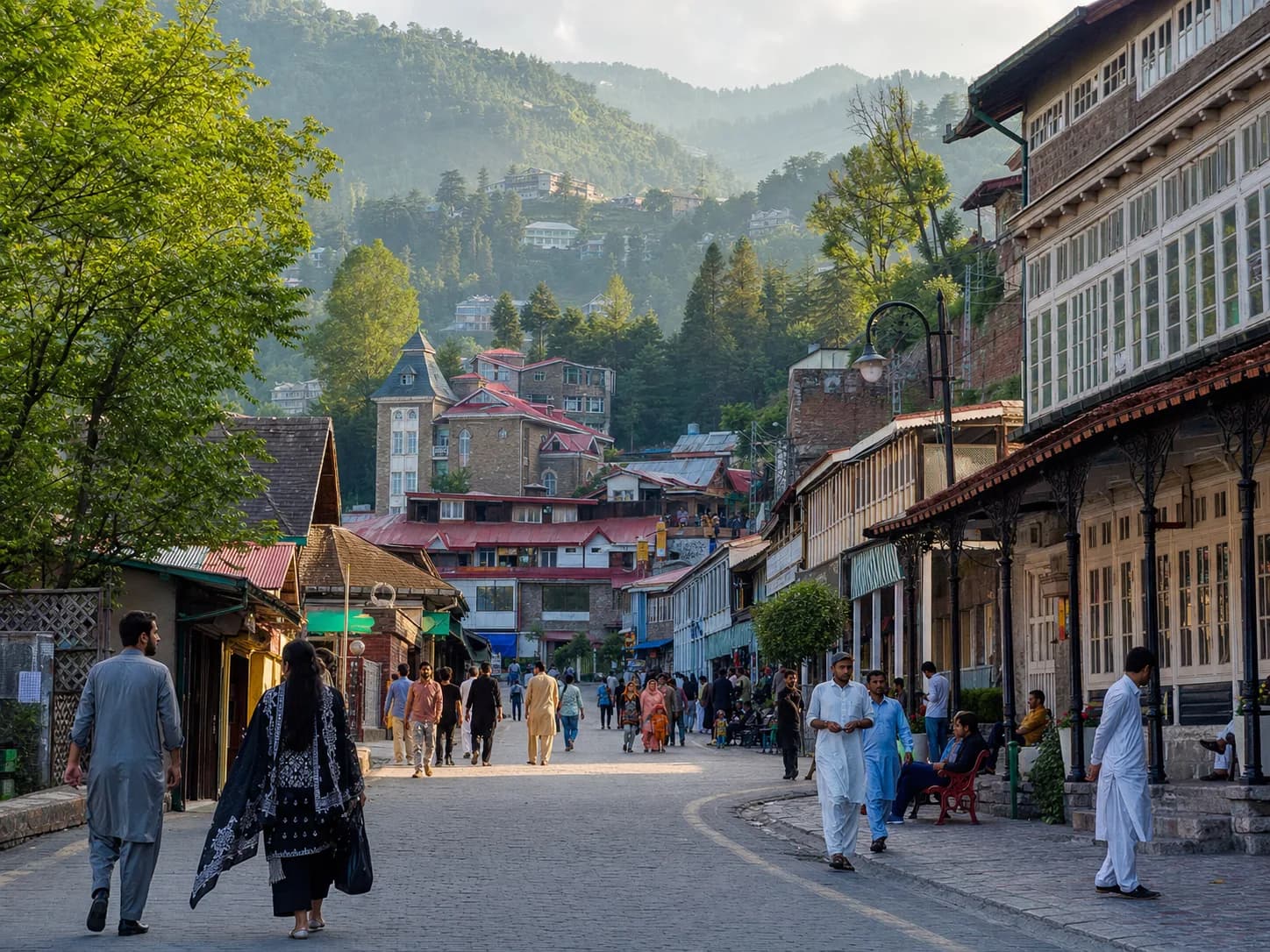 Open
OpenPunjab
Murree has two peaks a year, the June to August heat escape and the late December snow rush, and rates roughly double in both.
 Open
OpenPunjab
Bhurban is where corporate offsites and resort weekends go when Murree Mall Road is too crowded, about fifteen minutes short of it.
 Peak
PeakKhyber Pakhtunkhwa
Abbottabad is the junction town for both the Galyat and the Kaghan valley, and the last place with full-service hotels before either.