 Peak
PeakNeelum Valley
Azad Jammu & Kashmir
The valley road runs roughly 240 kilometres from Muzaffarabad to Taobat, and the last third is slow, rough and open only in summer.
from Rs 4,500/nightView stays
Destination guide
Muzaffarabad sits at about 740 metres where the Neelum meets the Jhelum, three and a half to four hours from Islamabad by either of two routes. Rooms run Rs 4,500 to Rs 9,000, and Rs 12,000 to Rs 18,000 river-facing. It is the last town with reliable banks, fuel and workshops before the Neelum valley.

Muzaffarabad sits at around 740 metres where the Neelum river meets the Jhelum, which makes it warmer than most Kashmir destinations and greener than the plains. It is the capital of Azad Jammu & Kashmir and, in practice, almost everyone here is either working in it or passing through it on the way up the Neelum valley.
That gives the town a specific and useful role. It has the last reliable banks, ATMs, fuel and vehicle workshops before the valley road, so it is where you draw cash for a trip that will be entirely cash, fill the tank, and fix anything that has started making a noise. Doing that here rather than assuming Kutton or Keran will provide it is the single most useful thing a Neelum-bound traveller can take from this guide.
It is not only a staging post, though. Pir Chinasi is a genuine half-day trip, the confluence is worth walking to, and the town's own recent history is visible in a way few Pakistani cities' are. A night here is not a wasted night, which is fortunate, because the timing of most Neelum trips means you will probably be spending one.
Both routes take about three and a half to four hours, and the choice between them is a choice about what kind of day you want. The Murree and Kohala road is more scenic and slower, and it has the practical advantage of doubling as a first-night option in Bhurban if you would rather split the drive and arrive fresh.
The Mansehra and Garhi Habibullah road via the Hazara Motorway is faster and better surfaced. It is the sensible default if Muzaffarabad is a waypoint rather than the destination, and particularly if you are trying to reach Kutton or Keran with daylight left.
Coaches run daily from Rawalpindi for anyone not driving. Whichever way you come, arrival time matters more than usual here: if you get in after mid-afternoon and the Neelum valley is your real destination, the right decision is to stop for the night. The valley road is not one to be driving after dark.
April to October is the season, and May, June and September are the most comfortable months in it. At 740 metres this is a low, warm town by Kashmir standards, so July and August are humid rather than cool — a distinction worth understanding if you are picturing hill-station weather and booking a summer break.
July and August also bring the monsoon, which triggers landslides on the Neelum valley road above the town and can hold traffic for hours. Muzaffarabad itself stays open and accessible throughout; it is the road out of it that becomes unpredictable. If a summer trip is what your dates allow, build slack into it and do not schedule anything immovable on the return day.
Winters here are cool and wet rather than snowy, and the town stays fully accessible year-round. That makes it one of the few Kashmir destinations with a genuine off-season rather than a closure, and rates hold steady outside July and August and the Eid holidays.
A mid-range double runs Rs 4,500 to Rs 9,000. The better river-facing properties on the Chehla Bandi side sit at Rs 12,000 to Rs 18,000. These are indicative bands rather than live rates — availability and the real figure for your dates come back on a quote.
Rates hold steady for most of the year, which is unusual in this part of the country and one of the reasons Muzaffarabad works as a fallback. The two exceptions are July and August, when Neelum-bound traffic fills the town, and the Eid holidays, when families travelling up the valley book everything within days. If your trip falls in either, treat the Muzaffarabad night as something to reserve rather than something to sort out on arrival.
The rest of the budget for a Muzaffarabad stay is small — this is not an expensive town. The costs worth planning for are the ones you incur here for use further up: cash for the whole Neelum trip, a full tank, and whatever the vehicle needs.
Hotels concentrate near Domel and along the Neelum Road out of town. Neelum Road is the obvious choice if the valley is where you are going next, since it puts you on the right side of town for an early start. Domel is central and convenient for the confluence.
The better properties are on the Chehla Bandi side facing the river, in the Rs 12,000 to Rs 18,000 band. That is where to spend the money if the stop is a night of the holiday rather than a night of the journey.
Upper Adda holds the bus stands and the cheaper stock, which is useful if you are arriving by coach and leaving by coach and busy otherwise. Current rates and what is actually free on your dates live on the Muzaffarabad hotels hub.
Pir Chinasi is the standard half-day trip: a shrine on a 2,900-metre ridge about thirty kilometres east of town, reached by a narrow paved road in roughly ninety minutes. It gives long views over Muzaffarabad and both river valleys. Go in the morning — afternoon cloud frequently closes the view entirely, and there is no consolation prize for having driven ninety minutes up a narrow road to look at the inside of a cloud.
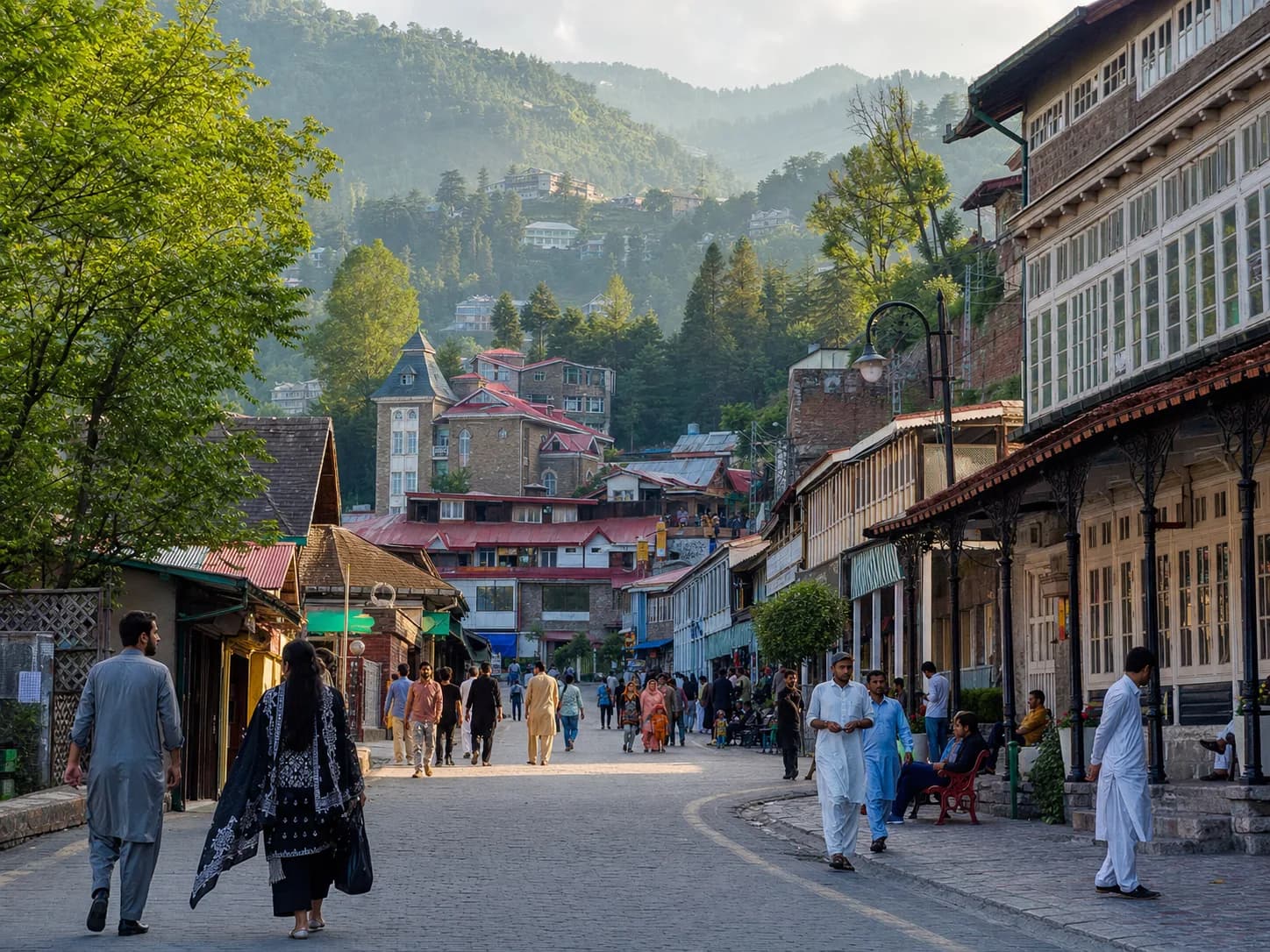
In town, the Red Fort restoration above the Neelum river is the thing to see. Muzaffarabad was in the epicentre area of the 2005 earthquake and much of what you look at is rebuilt, which gives walking around it a different weight than it otherwise would have. It is not a heritage town in the ordinary sense, and knowing why is part of visiting it well.
Beyond those, the confluence itself is the town's defining feature and worth the walk. A full day covers Pir Chinasi in the morning and the fort and the rivers in the afternoon, which is about the right length for a stop that most people are making on the way to somewhere else.
Most people in Muzaffarabad are on their way to the Neelum valley, and a few things are much easier to arrange here than up there. Draw cash for the whole trip: there are no dependable ATMs above this town and card payment is not accepted in the valley. Fill the tank. Get anything mechanical looked at.
Timing is the other decision. If you arrive from Islamabad after mid-afternoon, stop here — the Neelum road is not one to drive after dark. If you get in by noon, most travellers push on to Kutton or Keran and use the daylight, which is what summer trips generally do.
One point for visitors on a foreign passport. Muzaffarabad itself is straightforward. Areas further up the Neelum valley run close to the Line of Control, and foreign nationals are generally required to obtain a No Objection Certificate before travelling into those sections — arranged before leaving Islamabad or Muzaffarabad rather than at a checkpost partway up. Requirements change and we are not the authority on them: we do not process permits or issue NOCs, and nothing here is legal advice. Confirm the current position with the relevant authority before you travel.
Two days is what Muzaffarabad supports on its own terms — a half day for Pir Chinasi, a half day for the town, and a night at each end of it. Most people fold this into a longer Neelum trip rather than travelling here specifically, which is a reasonable way to use it.
Three and a half to four hours by either route: the Murree and Kohala road if you want the scenery and possibly a night in Bhurban, the Mansehra and Garhi Habibullah road via the Hazara Motorway if you want speed and surface. Take a room near Domel, along Neelum Road, or river-facing on the Chehla Bandi side at Rs 12,000 to Rs 18,000.
Up to the 2,900-metre ridge in the morning — thirty kilometres east, roughly ninety minutes on a narrow paved road, and afternoon cloud regularly closes the view, so this is a morning trip and not a flexible one. Back down for the Red Fort restoration above the Neelum river and the confluence in the afternoon.
If the Neelum valley is next, this is the morning to leave: draw cash for the whole trip, fill the tank, and go early enough to reach Kutton or Keran in daylight. If you are heading home, the Murree and Kohala road makes the better return of the two and lets you break the drive at Bhurban.
The guide stops where the booking starts. Rates, areas and availability live on the hub pages, and one request reaches the guesthouses and rest houses that never appear on the big booking sites.
Most trips to Muzaffarabad pair with somewhere close by. These are the stops travellers add most often.
PeakAzad Jammu & Kashmir
The valley road runs roughly 240 kilometres from Muzaffarabad to Taobat, and the last third is slow, rough and open only in summer.
 Open
OpenIslamabad Capital Territory
Guesthouse rooms in F-6 and F-7 sell out four to six weeks ahead through wedding season, October to March.
 Open
OpenPunjab
Murree has two peaks a year, the June to August heat escape and the late December snow rush, and rates roughly double in both.
 Peak
PeakKhyber Pakhtunkhwa
Abbottabad is the junction town for both the Galyat and the Kaghan valley, and the last place with full-service hotels before either.